WellDiver
- 4.7
- Rating
- 10.00K
- Installs
- Free
- Price

 Analysis by App-foxy
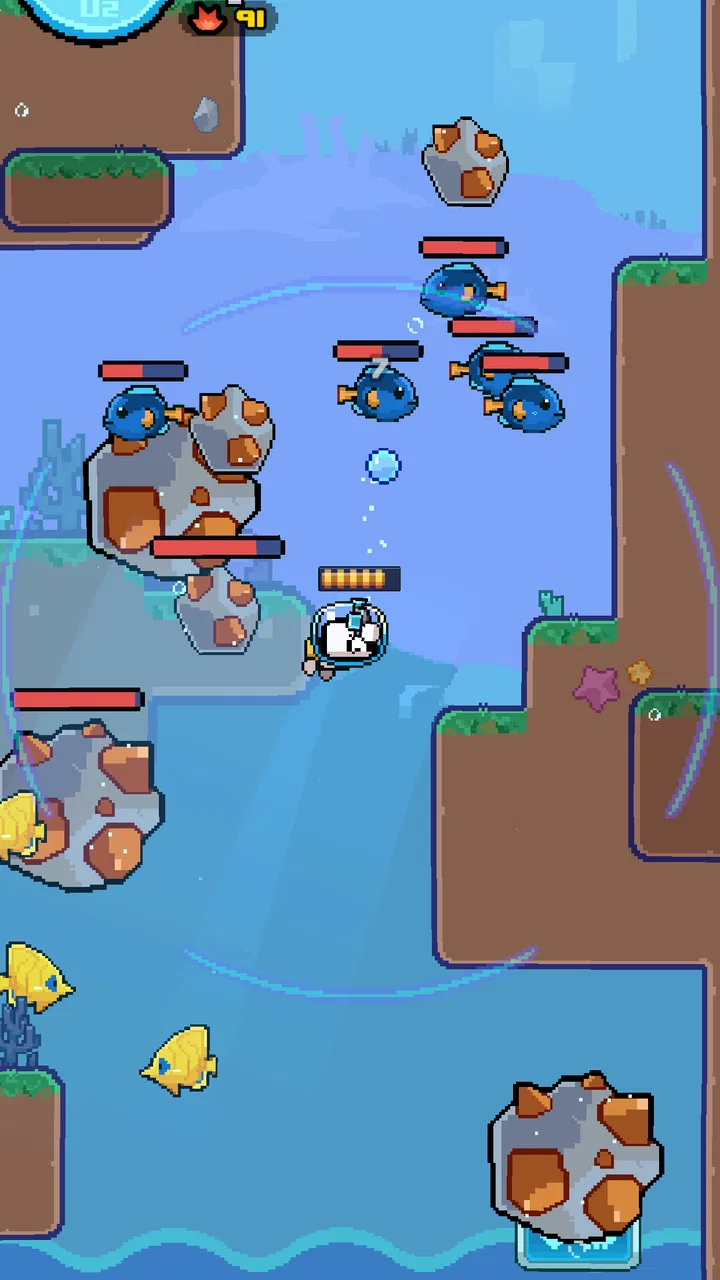
I went into WellDiver expecting a quick adventure game with a clear survival hook, and that is the right way to approach it. LoadComplete presents an ocean-focused challenge rather than a relaxed sightseeing experience: the central idea is to stay alive, make progress, and find a way out. That gives each session an immediate purpose, which I appreciated when I wanted something more focused than a large, open-ended adventure.
It is a free game in the adventure category, rated for Everyone, with optional in-app purchases ranging from $1.99 to $49.99 per item. The audience response is encouraging, with a 4.6 average from around 311 ratings, while the install count has passed 10K. Those figures suggest a small but interested player base rather than a massive mainstream release. I would treat that as a reason to try it with realistic expectations: this is a compact, developing experience, not a substitute for a huge console-style ocean adventure.
What to expect when you enter the ocean
The first thing to understand is the tone. The phrase “extreme survival action” is not just decoration; the game is built around pressure. You are not simply moving through water to admire the setting. You are trying to solve the immediate problem of surviving long enough to escape. That changes how I played. Instead of wandering without a plan, I paid attention to the safest route, the timing of my decisions, and whether a tempting move was worth the risk.
You May Also Like

 AccuWeather: Weather Radar
AccuWeather Review: A Quick, Clear Forecast for Everyday Decisions
For everyday plans, the best forecast is the one you can understand quickly. AccuWeather makes rain timing, radar, and local conditions easy to act on, with a few trade-offs.

 Hill Climb Racing
Why Hill Climb Racing Still Turns Crashes Into One More Run
A tiny car, a bumpy hill and one more upgrade: Hill Climb Racing keeps resurfacing because its simple chaos makes every near-miss feel personal.

 AliExpress - Shopping App
AliExpress Makes Global Shopping Feel Personal, but Shoppers Bear the Risk
AliExpress turns a global marketplace into a pocket-sized discovery engine. Its reach is useful, its shopping loop compelling, and its trade-offs easy to miss.

 Lords Mobile: Kingdom Wars
Lords Mobile Is a Kingdom-Building Routine, Not a Quick Match
A case-by-case verdict on the building, battles, device demands, and social commitments that make Lords Mobile rewarding for some players and exhausting for others.

 PDF Scanner app - TapScanner
TapScanner Makes Paperwork Easier to Capture, Check, and Share
TapScanner makes scanning with a phone feel less like a rescue operation and more like a dependable step in getting work done. Its capture tools are useful, though not flawless.

 Block Blast!
 Shows How Much a Puzzle Game Can Leave Out
A quiet grid game shows why puzzle players increasingly value instant clarity, repeatable skill and low-pressure play—and where the genre still needs to catch up.
More From Our News Desk
View All News


That makes the game a better fit for players who enjoy short bursts of tension. If you like adventure games where the environment itself creates the challenge, the ocean setting gives WellDiver a clear identity. It also works for someone who wants a game that can be understood quickly, without first learning a complicated fictional universe or managing a long list of unrelated objectives.
At the same time, I would not recommend it to everyone who likes water-themed games. Players looking for a calm exploration experience, extensive construction, or a deep story may find the survival emphasis too direct. The appeal here comes from acting under pressure, not from turning the ocean into a peaceful holiday destination.
The current version is 0.12.2, which is worth keeping in mind when deciding how much polish to expect. A version number at this stage usually means the experience may still be evolving. I noticed that this matters more for expectations than for the basic decision to try it: the game can still be enjoyable, but I would approach it as an active, early-stage adventure rather than a finished, feature-heavy classic.
Who will get the most from it
WellDiver suits players who like a clear risk-and-reward loop. You see a possible route or opportunity, decide whether it is safe enough, and then deal with the consequences. That structure is more satisfying when you are willing to repeat a situation and improve your judgment instead of expecting to succeed immediately.
It is also a reasonable choice for someone who wants an adventure game that does not require a major time commitment before the first meaningful moment. The ocean setting gives the game a strong theme from the start, and the escape objective keeps the experience from feeling directionless. I found that useful when I had only a short break and wanted something with a beginning, a problem, and a clear reason to keep going.
On the other hand, I would skip it if your main priority is a highly social game, a long narrative campaign, or a large collection of systems to master. The game’s strength is concentration. That same focus can feel limited if you want constant variety or a large amount of content immediately.
Getting through the first session without unnecessary confusion
Starting a new survival game can be intimidating because the screen often presents danger before the player understands the rhythm. My advice is to resist the urge to rush during the opening moments. First, learn how movement feels, notice how the game communicates danger, and identify what counts as progress. That simple pause is more useful than trying to make a dramatic escape on the first attempt.
The setup itself is straightforward in practical terms: install the game on a device running Android 8.0 or later, open it, and begin learning through play. Because the game is free to download, there is no purchase decision blocking the first test. I recommend treating the opening session as a tutorial you control. Do not judge the whole experience by how quickly you fail; judge it by whether the second attempt gives you a clearer plan.
One helpful habit is to separate observation from action. On the first run, focus on how the environment behaves and how the game signals a safe or unsafe decision. On the next run, change only one thing. This makes it easier to tell whether your improvement came from choosing a better route, reacting earlier, or simply understanding the controls.
That approach is especially useful on a phone. Touch controls can feel natural once you know what each gesture or button is doing, but uncertainty makes every mistake feel like a control problem. I found it better to make deliberate, small inputs than to react with frantic taps. In a survival game, panic often creates a second problem before the first one is solved.
The first meaningful success
Your first real success should not be defined only by reaching the escape point. A meaningful win can be making it farther than before, recognizing a threat early, or choosing not to take a risky path. Those smaller improvements are important because they turn failure into information instead of wasted time.
For a first-time player, I would use a simple three-step routine. Begin by learning the immediate surroundings. Then choose a conservative route that lets you observe how danger develops. Finally, attempt a faster or more ambitious move only after you understand what caused the earlier attempt to end. This is not the most dramatic way to play, but it gives you a reliable path toward your first successful escape.
A useful, less obvious tip is to avoid changing several decisions at once. If you move differently, take a new route, and spend resources differently in the same attempt, you may succeed without knowing why. Repeating the same opening while changing one choice creates a personal map of the game’s logic. That is more valuable than relying on luck.
Another practical insight is to stop a session after a clear improvement instead of immediately chasing a perfect run. Survival games can encourage “one more attempt,” but fatigue makes reaction-based decisions worse. If you have just learned a safe pattern, ending there can make the next session more productive. You return with a plan instead of a memory of increasingly rushed failures.
Where new players commonly misread the experience
The biggest misunderstanding is expecting the ocean to function like a normal exploration map. In WellDiver, the setting is part of the pressure. A visually interesting direction may not be the sensible direction, and the shortest route is not automatically the safest. I had better results when I treated every movement choice as a decision with a cost rather than as simple sightseeing.
Another source of confusion is the difference between progress and completion. A failed attempt can still teach you which behavior to avoid next time. If you only count a session as worthwhile when you escape, the game may feel harsher than it needs to. When I instead tracked what I had learned, the challenge became more readable and less random.
Players may also wonder whether the free version is enough to evaluate the game. In my view, yes: the absence of an upfront price makes it sensible to try the basic experience before considering any optional purchase. The in-app purchase range is broad, so I would avoid buying anything during the first session. First decide whether the survival loop itself is enjoyable; purchases cannot fix a gameplay style that does not suit you.
That is also where I would be careful with younger players. The game is rated Everyone, but the survival-action framing can still create moments of pressure. The age rating tells you the intended content level, not whether every player will enjoy the intensity. A child who prefers gentle exploration may respond differently from one who enjoys challenge and repetition.
How it compares with familiar adventure alternatives
Compared with relaxed exploration games, WellDiver is more about urgency than discovery. You are less likely to play it for a slow tour of a world and more likely to play it for the satisfaction of making a difficult sequence work. That distinction is important because it determines whether the game feels exciting or restrictive.
Compared with larger survival adventures, it is easier to approach because the premise is concentrated around the ocean and escape. The trade-off is that players who enjoy crafting trees, extensive building, or many parallel objectives may prefer a more expansive alternative. Those games offer more long-term variety, while WellDiver offers a cleaner immediate question: can you survive and get out?
Compared with reflex-only action games, it asks for more judgment. Speed matters, but blindly moving faster is not the same as playing better. I liked that balance because it rewarded attention rather than just quick fingers. Still, anyone wanting a pure arcade experience may find the decision-making slower than expected.
Practical advice for deciding whether to continue
After the first few sessions, I recommend choosing a personal goal instead of simply replaying the same escape attempt. You might focus on reaching a difficult area with fewer mistakes, learning a particular danger, or completing a route without panic. A goal like that gives the repetition a purpose and helps you decide whether the core loop has enough depth for you.
If the game feels unfair, check whether the problem is actually uncertainty. Ask yourself what you knew before making the failed move. If the answer is “almost nothing,” spend the next attempt observing rather than forcing progress. If you understand the risk and still dislike the result, that is a genuine preference issue, and a slower exploration game may be a better match.
I would also make the purchase decision gradually. Since the game is free and optional items cost between $1.99 and $49.99 each, there is no sensible reason to spend before you know how often you will return. Play enough to learn whether you enjoy the escape loop, then consider whether an optional purchase adds value to your own routine. For me, the strongest reason to keep playing is the challenge itself, not the promise of accelerating through it.
In an everyday scenario, I can see WellDiver working well during a commute break, a short wait, or a few minutes before bed, provided you enjoy ending a session on an unresolved challenge. I would be less likely to choose it when I wanted to relax completely, because the survival pressure asks for attention. That difference is small but important: this is a game for focused downtime, not passive downtime.
LoadComplete has created a focused adventure with a memorable setting and an easy-to-understand objective. The ocean gives the game atmosphere, while the escape goal gives each attempt direction. I especially liked the way small improvements can make a difficult run feel more manageable, even when the overall experience remains demanding.
My recommendation is to install it if you enjoy survival action, repeated attempts, and learning through mistakes. Start slowly, treat the first run as reconnaissance, and delay optional spending until the basic loop has earned your time. If you want a huge world, a deep story, or a peaceful underwater journey, choose another kind of adventure. For everyone else, WellDiver is a worthwhile free experiment, with enough tension to make a successful escape feel earned.
FAQs for WellDiver
01What is WellDiver and what can I use it for?
WellDiver is a wellness-focused app designed to help users explore and manage different aspects of their personal well-being. Depending on the features available in your region, it may provide guided activities, educational content, progress tracking, reminders, or tools for building healthier routines. It is best viewed as a supportive lifestyle companion rather than a replacement for professional medical advice or treatment.
02Is WellDiver free to download and use?
WellDiver may be available to download at no initial cost, but some features or content can require in-app purchases, a subscription, or an upgraded account. Before confirming any payment, review the pricing, billing frequency, trial conditions, and cancellation policy shown in the app store or inside the application. Availability of free features and premium tools may also vary between Android and iOS.
03Does WellDiver require an account or an internet connection?
Some functions of WellDiver may be accessible immediately, while others can require registration with an email address, social login, or another account method. An internet connection is generally useful for signing in, synchronizing progress, loading new content, and receiving updates. If offline access is supported, it may be limited to previously downloaded material, so users should check the app’s current requirements before relying on it without connectivity.
04Is WellDiver suitable for everyone, including users with health conditions?
WellDiver can be useful for people who want to organize wellness activities and develop healthier habits, but suitability depends on the individual and the specific tools being used. Users with medical conditions, injuries, pregnancy, mental-health concerns, or ongoing treatment should consult a qualified professional before following recommendations that could affect their health. Stop using any feature that causes discomfort and seek appropriate advice when necessary.
05What privacy information does WellDiver collect?
Because wellness applications may handle personal details, activity information, preferences, or health-related data, it is important to read WellDiver’s privacy policy before creating an account. Check what information is collected, why it is used, whether it is shared with service providers, and how deletion requests are handled. Also review device permissions and disable access that is not necessary for the features you intend to use.
Pros
- Clear guidance makes diving exercises easy to follow.
- Progress tracking helps users stay motivated over time.
- Suitable for practicing breathing and relaxation at home.
- Simple interface keeps navigation quick and distraction-free.
- Useful companion for divers preparing outside the water.
Cons
- It cannot replace supervised training or real-world diving practice.
- Some features may require compatible sensors or additional equipment.
- Results depend heavily on consistent
- correct exercise technique.
- Content may feel limited for experienced divers seeking advanced plans.
- Availability and feature support may vary between Android and iOS.

WellDiver
Gallery